
Have you ever looked at a piece of sheet music and thought, “What in the world am I supposed to do with all THAT?”
All those dots, lines, symbols, strange Italian words, and numbers!
It’s enough to make anyone wonder whether they accidentally signed up for a course in decoding ancient hieroglyphics.

If you’ve ever felt overwhelmed by music theory, I have some encouraging news.
Music theory isn’t nearly as scary as it might seem.
And even better?
You don’t have to understand everything at once to begin enjoying it.
Let’s explore why music theory can feel intimidating and how we can change that.
I’ve been teaching piano for more than 25 years. I’m a Nationally Certified Piano Teacher with a background in jazz theory. I play piano and organ for my
church, and for nearly 10 years I’ve played harp for hospice patients. In all that time, the adults who walk into my studio have rarely lacked ability. What they
usually bring with them is a worry that music theory is meant will be hard.
First, Let’s Talk About That Fear
Many adults approach music theory carrying memories of past experiences.
Maybe you took lessons as a child and struggled to remember the notes.
Perhaps your teacher moved too quickly, or you were afraid to ask questions.
Maybe someone told you that you didn’t have musical talent.
Or perhaps you’ve simply looked at a piece of sheet music and decided it was too complicated to understand.
Those experiences can make learning music feel like something to avoid rather than enjoy.
But I want you to remember something important:
Your past struggles with music don’t determine what you’re capable of learning today.
You may simply need a different approach, clearer explanations, and a little encouragement along the way.
Reason #1: Music Theory Has Its Own Language
Music theory introduces words we don’t necessarily use in everyday conversation.
Treble Clef.
Time signature.
Quarter note.
Key signature.
Intervals.
And just when you’re getting comfortable, someone mentions allegro!
Wait a minute. Are we learning music or ordering dinner in Italy?
Here’s the good news.
You don’t need to master every musical term before you can begin understanding music.
Just as you learned to read words one letter at a time, you can learn to read music one concept at a time.
Start with something simple. Learn what the staff is.
Understand what a clef tells you. Recognize a few notes.
Then build from there.
There’s no need to tackle the entire musical dictionary in one afternoon!
Reason #2: We Think We’re Supposed to Understand Everything Immediately
As adults, we’re used to knowing how to do things.
We manage jobs, families, schedules, responsibilities, and all sorts of everyday challenges.
So when we sit down to learn something unfamiliar, it can feel uncomfortable.
Suddenly, we’re beginners again. And being a beginner can feel frustrating.
But here’s something worth remembering:
Being a beginner isn’t a weakness. It’s the starting point of learning something wonderful.
You don’t have to recognize every note the first time you see it.
You don’t have to understand every rhythm immediately.
And you certainly don’t have to get everything right.
Learning music is a process, not a race.
Reason #3: We Confuse Mistakes with Failure
Have you ever played the wrong note and immediately thought, “See? I knew I couldn’t do this”?
Let’s change that conversation.
A wrong note isn’t proof that you’re incapable.
Instead, it simply tells you there’s something to practice.
In fact, every musician, from beginners to professionals, works through challenges.
You are allowed to make mistakes.
You are allowed to ask questions.
And you are absolutely allowed to laugh when your fingers and your brain aren’t quite cooperating!
Music is supposed to bring joy into our lives, not make us afraid to try.
Reason #4: We Try to Learn Too Much at Once
Imagine someone handing you an entire cookbook and telling you to memorize every recipe before making dinner.
Sounds ridiculous, right?

Yet sometimes we approach music theory in exactly that way.
We think we need to learn every note, rhythm, symbol, and rule before we can understand anything.
But that’s simply not necessary. Instead, you can begin with one small concept.
Practice it until it feels more familiar.
Then add another. Little by little, those unfamiliar symbols start making sense.
And that’s when something exciting happens.
Instead of seeing a page full of confusing marks, you begin recognizing musical information.
Let’s Make Music Theory a Little Less Mysterious
Ready for a tiny lesson?
Let’s look at the musical staff.
A staff has five horizontal lines and four spaces. That’s it!
In other words, those lines and spaces give us places to write musical notes.
A clef, such as the Treble Clef, helps us identify which pitches those notes represent.
In my last post, we learned that the lines of the treble clef staff, from bottom to top, are:
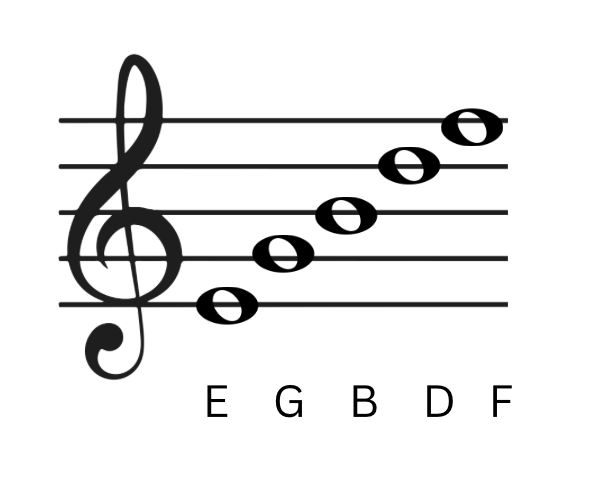
E – G – B – D – F
Now let’s add something new.
The four spaces, from bottom to top, are:
F – A – C – E
Notice anything interesting?
They spell the word FACE!
How convenient is that?
Now you know the names of the notes on both the lines and spaces of the Treble Clef Staff.
You don’t have to recognize them instantly yet.
For now, just begin getting comfortable with where they belong.
That’s how understanding grows.
One small musical discovery at a time.
What If We Made Learning Music Enjoyable Again?
Imagine sitting down with a piece of music and feeling curious instead of intimidated.
Imagine recognizing a few notes without immediately second-guessing yourself.
Picture yourself feeling comfortable asking questions because you know learning takes time.
That’s the kind of musical experience I want adults to have.
Not one filled with pressure and perfectionism.
But one built around understanding, encouragement, and the joy of discovering how music works.
Your Next Step
Here’s a little challenge for this week.
Find a piece of sheet music written in treble clef. Look for one note sitting in a space.
Can you figure out whether it’s F, A, C, or E? If you can, celebrate!
If you’re not sure, that’s okay. Look at the four spaces again and try.
Remember, you’re learning.
And every small step counts.
Let’s Learn Together!
I’d love to hear from you.
What part of music theory feels the most intimidating?
Is it reading notes? Understanding rhythm? Remembering all those musical terms?
Share your thoughts in the notes section when you take the quiz below. I read every single one.
And if you’d love a friendly place to ask questions and learn with other adults, I invite you to join my free Facebook group.
We believe music theory can be learned with confidence, encouragement, and joy.
And you don’t have to do it alone! 🎶
Curious where you’d start? Take my free 8-question music theory quiz and get a handout matched to where you are right now.